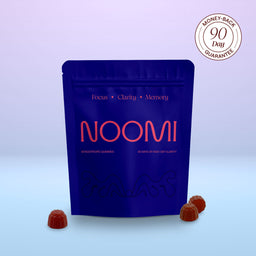
Why Noomi doesn’t include caffeine, Lion’s Mane, Panax ginseng, Ginkgo biloba, or “mushrooms”
People ask this because they’re not irrational.
They see Lion’s Mane everywhere. They’ve heard ginkgo is “for memory.” They know ginseng is “for energy.” And they assume any “serious” nootropic should include them.
So here’s the direct answer:
We didn’t exclude them because they’re “bad.”
We excluded them because they didn’t fit this product’s job.
Noomi is one workday routine (4 gummies) built to help support:
- cognitive function / brain health
- memory support
- mental focus and mental stamina
- temporary relaxation
- energy and resistance to stress over time
In Canada, marketing claims also need to stay consistent with the product’s authorized scope and conditions of use. You can paraphrase, but you can’t stretch it.
If you want to know more about what's in Noomi, we have the right articles for you:
- The science behind Noomi: what research can (and can’t) say about focus, memory, and stress
- Noomi formula breakdown: practical effects, timelines, and trade-offs
In this post, we will review some ingredients we have intentionally kept outside of Noomi.
The real reason most “kitchen sink” formulas disappoint
There’s a common mistake in supplement design: “Add more popular ingredients. People will trust it.”
That approach creates three problems:
-
Dosing becomes fake.
15 ingredients in a gummy often mean they are utterly underdosed. -
Evidence becomes unreadable.
You can’t tell what’s doing what. You can’t test anything. -
Risk goes up silently.
Some herbs have real drug interaction profiles. Adding them “because marketing” is sloppy.
Noomi is the opposite approach:
- fewer ingredients that each have a job
- disclosed dosage, based on available monographs
- standardized extracts where it matters
- conservative claim language
Now let’s address the specific “missing” ingredients.
0) Why we didn’t include caffeine
What people expect caffeine to do
They want a quick lift:
- more alert
- more drive
- faster start to the day
Caffeine can increase arousal and vigilance. At higher doses it also increases tension and can worsen anxiety-type symptoms in some people.
Why we avoided it in Noomi
We didn’t want “padding” that makes a product feel strong on day one, but doesn’t help the long game.
Noomi is meant to support focus, mental stamina, memory, and stress support without building a dependence loop around a stimulant.
The downsides that matter for a daily workday gummy
1) Jitters, nervousness, irritability
Health Canada lists side effects such as insomnia, irritability, headaches, and nervousness.
Caffeine use is also associated with anxiety and sleep problems in guidance from NCCIH.
2) Sleep disruption (even if you take it “not that late”)
A controlled study found caffeine can disrupt sleep even when consumed 6 hours before bedtime.
If sleep quality drops, focus usually drops with it. (That’s not a supplement problem. It’s a biology problem.)
3) The “crash” problem is often rebound + sleep debt + withdrawal
Many people describe a crash. Mechanistically, part of what people call a crash is:
- short sleep the night before (caffeine masking fatigue)
- rebound sleepiness later
- withdrawal effects if daily intake is high or timing is inconsistent
Caffeine withdrawal commonly includes fatigue/drowsiness, decreased alertness, difficulty concentrating, irritability, and headache.
4) It complicates the signal
If caffeine is inside the gummy, you can’t tell whether:
- the formula helped, or
- the stimulant carried the day
You want a routine you can evaluate, not a permanent “on/off” loop.
Most of Noomi's fans are coffee enthusiasts (us included). We wouldn't force you to choose between Noomi and your morning treat!
If you still want caffeine
Caffeine isn’t “bad.” It’s just not what we wanted inside Noomi.
If you use it, do it deliberately:
- keep the dose and timing consistent and reasonable
- protect sleep (because caffeine can impair it even hours before bed)
- taper instead of quitting abruptly if you’re a daily user (withdrawal is common)
1) Why we didn’t include Lion’s Mane (Hericium erinaceus)
What people think Lion’s Mane does
“Neurogenesis.” “Nerve growth factor.” “Brain repair.”
Online, it gets treated like a brain upgrade.
What the human evidence looks like
There are human studies. The issue is that the evidence is still:
- limited in size
- mixed in outcomes
- often in specific populations (older adults / MCI)
- clinically recognized as a source of immunomodulating and antioxidants - not cognitive support
Example signals:
- A 2023 randomized trial reported tentative cognitive/mood-related effects in healthy young adults, but also null and limited negative findings, with authors calling out small sample size and need for larger studies.
- A 2024 review of mushroom interventions reported mixed intervention results overall, with many studies focusing on Lion’s Mane and showing some enhancement signals in some contexts.
Some reviews summarize clinical trials in older adults/MCI and highlight promising results, but that’s not the same as “works for everyone who wants better focus at work.”
The practical problem: “Lion’s Mane” is not one thing
Products vary by:
- fruiting body vs mycelium
- extraction method
- standardization (often absent)
- active compound reporting (often absent)
So even if you believe in the ingredient, it’s hard to guarantee consistency in a mass-market gummy without a tight spec and reliable supply chain.
Why it didn’t fit Noomi
- evidence is still emerging and inconsistent across outcomes/populations
- product-to-product variability is high (harder to control in gummies)
- it would either reduce dosing space for Noomi’s core stack or become a “token dose,” which we won’t do
If you still want Lion’s Mane: buy it as a separate, standardized product where you can verify the exact extract and dose. Treat it as an experiment, not a guarantee.
2) Why we didn’t include Ginkgo biloba
What people think ginkgo does
“Memory.” “Circulation.” “Sharper thinking.”
It’s one of the most famous “brain herbs.”
The evidence reality (especially in healthy adults)
Ginkgo has been studied a lot, but “studied a lot” doesn’t mean “reliable benefits for your use case.”
Cochrane’s review concluded there is no convincing evidence that ginkgo is efficacious for dementia and cognitive impairment, and highlighted inconsistency and methodological issues in the evidence base.
Even when some meta-analyses find benefits in certain clinical contexts (often with standardized extract EGb 761), that still doesn’t automatically translate to “good daily add-on for healthy Optimizers.”
The bigger issue: interactions
This is the cleanest reason to exclude it from a broadly marketed “daily gummy”:
Ginkgo can increase bleeding risk in people taking anticoagulants like warfarin, and it can interact with other drugs.
There’s also ongoing research documenting interaction patterns with antiplatelets/anticoagulants.
If you sell a supplement to a broad adult population, you must assume:
- some customers are on anticoagulants/antiplatelets
- some customers have surgery scheduled
- some customers are managing chronic conditions
- taking diabetes, high blood pressure or seizure medications
Ginkgo has also been associated with:
- liver cancer
- effects on normal growth and development
Why it didn’t fit Noomi
- cognitive benefits are inconsistent across the populations people care about
- interaction and risks add unacceptable threats for a daily gummy
If you still want ginkgo: honestly, don't.
3) Why we didn’t include Panax ginseng
What people think ginseng does
“Energy.” “Stamina.” “Stress resilience.”
Some people also expect cognitive enhancement.
What the evidence says about cognition in healthy people
Cochrane’s summary is blunt: there’s a lack of convincing evidence for a cognitive enhancing effect of Panax ginseng in healthy participants, and no high-quality evidence for some claims.
Newer systematic reviews/meta-analyses also trend toward:
- small or mixed effects
- possible memory-specific signals
- limited improvements in overall cognition/executive function
- need for higher-quality trials
What about fatigue/energy?
NCCIH notes that evidence suggests ginseng alone may have a small beneficial effect on general fatigue, but not all research agrees.
So yes, there’s signal in fatigue contexts, but it’s not clean, and it varies by:
- the species (Panax ginseng vs American ginseng)
- dosing and duration
- whether it’s alone or part of a formula
Why it didn’t fit Noomi
- cognitive enhancement in healthy adults is not convincingly supported
- fatigue benefits look small/mixed, and we already cover “stress/fatigue” support with other components in a clearer stack
- adding it would either force underdosing elsewhere or bloat the formula without improving clarity
- and maybe more importantly, it conflicts with common diabetes, antidepressant, blood thinners or digoxin medications.
If you still want ginseng: pick a product that specifies the Panax species, extract type, and dose, and treat it as a separate fatigue-focused experiment.
4) Why we didn’t include other “mushrooms”
This one matters, because “mushrooms” in supplements has become a marketing word.
“Mushrooms” can mean:
- Lion’s Mane
- cordyceps
- reishi
- chaga
- a blend of five different species
- mycelium on grain (which changes what you’re actually buying)
Research reviews that look across mushrooms generally find:
- mixed intervention outcomes
- heterogeneity in species, extracts, and study designs
So the problem isn’t “mushrooms are useless.”
The problem is that “mushrooms” is often too vague to be a reliable, testable ingredient decision in a tight workday product.
Noomi’s approach is:
- choose specific ingredients with specific jobs
- ensure they have been clinically validated and recognized by Health Canada
- keep the stack testable, and inclusive of people with common conditions (high pressure, diabetes, ...).
- avoid trendy ambiguity
The real filter we use
When someone asks “why isn’t ingredient X in your product,” we run three checks:
-
Does it fit the claim scope and the job?
In Canada, health product claims should match the product’s authorization (NPN) in relation to scientific compliance publicly available on Health Canada's website. - What are the risks, interactions and downsides?
We want to keep the stack testable and inclusive of people with common conditions (high pressure, diabetes, ...). Safety is key! -
Can we dose it meaningfully in 4 gummies?
If it requires a dose that will unbalance the whole stack, we don’t include it, or make the whole ritual unpleasant, we skip it.
That’s the core logic behind Lion’s Mane, ginkgo, ginseng, and mushroom blends being excluded.
Bottom line
If you want a product that “includes everything popular,” Noomi is not that.
Noomi is built for:
- one workday routine
- disclosed doses
- a stack that supports focus, mental stamina, memory support, and stress support
- conservative claims that stay inside Canadian authorization expectations
If that’s what you want:
Get Noomi
noomigummies.com/product
Sources used in this article
- Ad Standards Canada, Guidelines for Consumer Advertising of Health Products (claims consistent with Terms of Market Authorization; avoid misleading impressions).
- Health Canada, Labelling Requirements Checklist (advertising claims on labels must not contravene Food and Drugs Act; align with Consumer Advertising Guidelines).
- Health Canada, Regulatory Requirements for Advertising (only authorized products may be advertised; regulatory framework).
- Lion’s Mane RCT (acute/chronic effects; tentative results; small sample; mixed findings): Docherty et al., 2023 (PubMed record).
- Review of mushrooms and mood/cognition (mixed intervention results; many Lion’s Mane studies): Cha et al., 2024.
- Lion’s Mane clinical trial context in MCI/older adults (review summary): Contato et al., 2025.
- Lion’s Mane systematic review overview (trial focus areas and limitations): Menon et al., 2025 (Frontiers in Nutrition).
- Cochrane review: Ginkgo biloba for cognitive impairment and dementia (no convincing evidence; inconsistency).
- NCCIH: Ginkgo safety and bleeding risk; drug interactions.
- Evidence on ginkgo interaction patterns (antiplatelets/anticoagulants) in clinical data: Mai et al., 2025 (PLOS ONE).
- Cochrane evidence summary: Panax ginseng and cognition in healthy people (lack of convincing evidence).
- Systematic review/meta-analysis on ginseng and cognitive function (mixed; memory signal; overall cognition/executive function often null): Zeng et al., 2024 (PubMed record) and associated publication listing.
- NCCIH: Asian ginseng and fatigue (small possible benefit; mixed evidence).