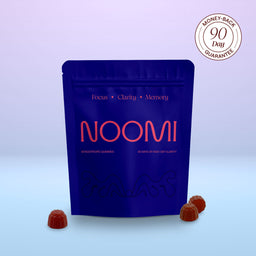
Noomi Ingredients breakdown
Most supplement labels have the same problem: they list ingredients, but don’t explain the role and required potency for each one.
So people fill the gap with guesses:
- “This one is for energy.”
- “This one is for memory.”
- “This one must be the magic one.”
Noomi is built as a stack, not a lottery ticket. Each ingredient has a job. Some are about focus. Some are about stress and relaxation. Some are about memory support. And some help when you’re under heavy demand.
Below is a practical breakdown for a daily serving (4 gummies):
- Acetyl-L-Carnitine HCl: 500 mg
- Bacopa monnieri: 300 mg
- L-Theanine: 200 mg
- Phosphatidylserine: 300 mg
- Rhodiola rosea root extract (3% rosavins, 1% salidrosides): 144 mg
- Alpha-GPC: 400 mg
- Ashwagandha: 300 mg
- L-Tyrosine: 500 mg
You can find more about research and evidence in The science behind Noomi: what research can (and can’t) say about focus, memory, and stress.
Quick mental model: what this stack is trying to do
Think of a high-output workday like driving on a highway.
- Focus is staying in your lane.
- Mental clarity is not fading after an hour.
- Memory support is not missing exits you already passed yesterday.
- Stress support is not gripping the steering wheel all day.
Noomi aims to support:
- cognitive function and brain health
- mental focus and mental stamina
- memory
- temporary relaxation
- energy and resistance to stress over time
Those are the clinical domains approved by Health Canada for Noomi as a licensed natural health product.
Ingredient-by-ingredient
1) Acetyl-L-Carnitine HCl (500 mg)
Why it’s here
-
ALCAR appears in research tied to cognition and fatigue in various clinical contexts.
What you should expect
- If you’re a healthy adult, the signal may be small or hard to detect.
- If you’re expecting a stimulant effect, you’re looking in the wrong place.
What research suggests (high level)
- Reviews discuss potential cognitive effects of acetyl-L-carnitine in cognitive disorders and related contexts; results vary by population and condition.
2) Bacopa monnieri (300 mg)
Why it’s here
-
Bacopa appears frequently in human cognition research, particularly in areas related to attention and memory.
What you should expect
-
Bacopa is more “over time” than “instant.” Many studies run for weeks, not days. In practice, it’s usually a slow-support ingredient, not a day-one jolt.
What research suggests (high level)
-
A meta-analysis of randomized controlled trials reported that Bacopa monnieri extract may improve cognition, particularly the speed of attention.
Common mistake
-
Taking it for three days, expecting fireworks, and calling it useless.
3) L-Theanine (200 mg)
Why it’s here
-
Theanine is used for “calm attention.” Not sedation. More like taking the edge off mental noise.
What you should expect
- If you’ve already mastered your inner calm, you may feel nothing.
- If you run “hot” (racing thoughts, tense baseline), this is one of the ingredients more likely to feel noticeable.
What research suggests (high level)
-
A randomized, placebo-controlled, double-blind trial in healthy adults found 4 weeks of L-theanine at 200 mg/day improved stress-related symptoms and included cognitive function outcomes.
Practical note
-
This is often the ingredient that makes “focus” feel smoother instead of sharper.
4) Phosphatidylserine (300 mg)
Why it’s here
-
PS is often discussed in memory/cognition support contexts.
What you should expect
-
Likely subtle in healthy young adults. Signals tend to increase in correlation with age in published research.
What research suggests (high level)
-
A randomized double-blind placebo-controlled trial reported cognitive improvements in older adults with mild cognitive impairment using a supplement containing phosphatidylserine (study context matters).
How to use this information
-
If your goal is “support memory,” you measure it over time. You don’t expect a single morning to prove it.
5) Rhodiola rosea extract (144 mg; standardized to 3% rosavins, 1% salidrosides)
Why it’s here
-
Rhodiola is often discussed for fatigue and stress adaptation.
What you should expect
- This is not “energy”, it is resilience.
- It’s more about how you feel under load (mental fatigue), and results vary a lot by person and context.
What research suggests (high level)
- A systematic review of trials on rhodiola for physical and mental fatigue found the evidence base is limited and heterogeneous (mixed methods and quality).
What it means
-
The goal is a stack where each piece has a plausible role. We understand that adaptogens, especially nootropics, have a different impact from one person to another. We want to build something solid that you can test in your own routine and context.
6) Alpha-GPC (400 mg)
Why it’s here
-
Alpha-GPC is used in cognition discussions, often tied to attention and performance tasks.
What you should expect
-
This is one of the more “acute” candidates (some people look for near-term effects), but the evidence isn’t uniform across all settings.
What research suggests (high level)
-
A 2024 study in healthy young males reported acute Alpha-GPC supplementation improved Stroop test performance measures versus baseline, providing evidence of short-term cognitive effects in that population.
Practical note
-
In conjunction with the rest of the stack, this ingredient will most likely support your intense deep work sessions.
7) Ashwagandha (300 mg)
Why it’s here
-
Ashwagandha is used in stress-related contexts. It’s not a productivity hack. It’s a stress-support lever.
What you should expect
- People usually notice an improvement in how they handle pressure in situations they would have otherwise been overwhelmed or on edge.
- If your stress is situational (deadlines, travel, overload), this can be relevant. If your stress is clinical, that’s a different category and should be handled with a clinician.
What research suggests (high level)
-
Systematic reviews and meta-analyses of randomized trials generally report reductions in stress/anxiety measures and sometimes cortisol compared to placebo, with calls for more long-term safety data.
8) L-Tyrosine (500 mg)
Why it’s here
- Tyrosine is usually positioned as “performance under stress.” Think: demand spikes, pressure, harsh conditions.
- As cognitive performance expectations have never been so high, and economic pressure so intense - living under pressure has become the new normal.
What you should expect
- A sustained resilience, not a quick hack.
- When the day is hard, you’re less likely to mentally collapse.
What research suggests (high level)
-
Controlled studies report that tyrosine can mitigate working memory decrements under cold-stress conditions.
Where people overreach
-
Calling tyrosine a general cure for focus. The evidence is more context-dependent than that.
How to know what’s working
A micro-story that’s common:
- You start a nootropic.
- Day 2 is great.
- Day 3 is awful.
- You conclude the product is random.
That’s usually just normal variance.
If you want a fair test:
- Track one work metric for 2–4 weeks (example: number of 45–90 min deep-work blocks completed).
- Track one subjective metric (end-of-day mental fatigue 1–10).
- Keep caffeine timing stable and reasonable.
This is measurement advice, not a scientific claim.
How Noomi is meant to be used
Your guidance:
- 4 gummies a day, before starting your day, on workdays
- pause on weekends
Two practical notes:
- If you’re sensitive to stimulation, make sure you do not take Noomi after noon.
- If you’re taking medications or managing a health condition, use professional advice for interactions.
Bottom line
Noomi isn’t built around one “hero ingredient.”
It’s built as a stack where each ingredient has a job:
- calmer attention (theanine)
- stress support over time (ashwagandha, rhodiola context-dependent)
- cognition and focus tasks (bacopa, alpha-GPC)
- memory support contexts (bacopa, phosphatidylserine)
- performance under acute demand (tyrosine)
- broader cognition/fatigue contexts (ALCAR, with realistic expectations)
If you want one workday routine and you prefer a gummy format that avoids sugar alcohols and gelatin (per Noomi’s positioning), that’s what Noomi is for.
Get Noomi
noomigummies.com/product
Sources used in this article
- Bacopa monnieri (meta-analysis of RCTs; cognition/attention speed): Kongkeaw et al., Journal of Ethnopharmacology (2014).
- L-theanine 200 mg/day for 4 weeks (randomized, placebo-controlled, double-blind; stress-related symptoms + cognitive function outcomes): Hidese et al. (2019).
- Ashwagandha and stress/anxiety outcomes (systematic review + meta-analysis): Arumugam et al. (2024).
- Rhodiola rosea and mental/physical fatigue (systematic review; evidence mixed/heterogeneous): Ishaque et al. (2012).
- Rhodiola trial showing worsened fatigue in shift-working nursing students (example of non-uniform outcomes): Punja et al., PLOS ONE (2014).
- Tyrosine under cold stress (placebo-controlled; mitigated working memory decrements): Mahoney et al. (2007).
- Alpha-GPC acute cognitive effects (Stroop performance; healthy young males): Kerksick et al. (2024).
- Phosphatidylserine in mild cognitive impairment (randomized, double-blind, placebo-controlled): Duan et al. (published 2024; indexed 2025 in journal issue listings).
- Acetyl-L-carnitine in dementia/cognitive disorders (review; mixed evidence, context-dependent): Pennisi et al. (2020).
- L-carnitine for cognitive enhancement in people without cognitive impairment (Cochrane review; no evidence of benefit in included trial data): Chen et al. (2017).