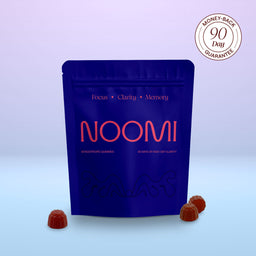
Nootropic gummies: what they are, what to look for, and why people choose them
If you’ve ever tried to “build a supplement stack,” you’ve experienced the challenge.
You start with one supplement for focus. Then you add one for stress. Then one for memory. Soon you’re managing many ingredients, juggling unpleasant powders and caps, timing rules, and a travel kit. You miss days. You can’t tell what helped. You quit.
Nootropic gummies exist to solve one problem: make the routine easier to follow. That’s it. Gummies are not automatically better. They’re just easier to take.
This guide helps you buy them without getting fooled.
What “nootropic” means (in the real world)
“Nootropic” is not a regulated promise. It’s a category label people use for supplements that aim to support cognitive performance.
In Canada, claims in marketing need to stay consistent with what the product is authorized to claim (label/monograph/licence scope). You can paraphrase, but you can’t expand the meaning.
Gummies vs capsules: what changes, what doesn’t
What gummies can improve
- Adherence: no water, easier to take, to remember, to travel with.
- Consistency: a simple morning ritual is easier to keep.
What gummies can make worse
- Underdosing: many gummy formulas can’t fit meaningful amounts.
- Label fog: “proprietary blends” hide real quantities.
- Sweetener tradeoffs: some gummies rely on sugar or sugar alcohols to taste good.
The right question isn’t “gummies or capsules?”
It’s “does the label support the outcome I’m buying?”
The buyer checklist
1) Do they disclose milligrams for each active ingredient?
If you can’t see amounts, you can’t judge it. Skip it.
2) Is the serving size realistic?
Some brands list “2 gummies” but only fit token doses. Others use 4–6 gummies to reach meaningful amounts. Bigger serving sizes are not “bad.” They’re often just honest.
3) Are botanicals standardized?
For certain herbs, “300 mg” can mean very different potency. Standardized extracts make comparison possible (example: Rhodiola standardized by rosavins/salidrosides).
4) Does the formula match your goal?
A practical way to think about “focus” supplements:
- mental stamina (less drop-off)
- memory support (usually shows up over time)
- calm attention (less mental noise)
If a product is mostly caffeine, it’s an energy product, not a focus product.
5) Are the claims restrained and consistent?
If a product implies it treats disorders, guarantees outcomes, or promises medical results, it’s a red flag. Cognitive performance, and how to address it, differ greatly from one individual to another based on age, context, medical history and many other factors. No notropic can claim they are universally effective. You have to find out which nootropic is working for you.
6) What else does the label tell you?
In today's day and age, everyone has grown more attentive to what they put in their body: Vegan, no added sugar, no sugar alcohol, no peptine, no GMO, produced in Canada. You can identify quickly when a product is made for you, and not solemly for the investors.
A simple way to judge a nootropic gummy label
Here’s the fast filter:
Green flags 🟢
- Full ingredient list with amounts in mg
- Standardized extracts when relevant
- Claims that sound like “helps support…” not “fixes…”
- Clear directions for use (dose, timing)
- Demonstrate safety (no toxic ingredients/process)
- Is registered in Canada (NPN number)
Red flags 🔴
- “Proprietary blend”
- Lots of ingredients with tiny “fairy dust” doses
- Overconfident medical-sounding promises
- No guidance beyond “take daily”
- Padded with stimulants and vitamins
Where the science tends to be solid vs messy
People want one headline: “Does it work?”
Science doesn’t work like that. Evidence depends on:
- what outcome is measured (reaction time, attention tasks, stress scales, memory tests)
- who is studied (healthy adults vs older adults vs specific stress contexts)
- dose and duration (single dose vs weeks)
A good example of “realistic evidence”:
- Bacopa monnieri: a meta-analysis of randomized controlled trials suggests cognitive benefits, particularly speed of attention, while emphasizing the need for larger, well-designed trials.
- L-theanine: a randomized controlled trial (200 mg/day for 4 weeks) reported improvements in stress-related symptoms and cognitive functions in healthy adults.
- Rhodiola rosea: a systematic review of controlled trials for physical/mental fatigue found mixed methods and quality; results aren’t uniform across studies and individuals.
That’s the pattern with most nootropics:
- some signal
- lots of variability
- outcomes vary between individuals
- consistency matters more than hype
Where Noomi fits
Noomi is one product meant to support:
- cognitive function/brain health
- mental focus and mental stamina
- memory support
- temporary relaxation
- energy and resistance to stress over time
It’s designed as a workday routine:
- 4 gummies before starting your day, on workdays
- pause on weekends
Noomi also makes the label readable by disclosing per-serving amounts (4 gummies):
- Acetyl-L-Carnitine HCl 500 mg
- Bacopa monnieri 300 mg
- L-Theanine 200 mg
- Phosphatidylserine 300 mg
- Rhodiola rosea extract 144 mg (3% rosavins, 1% salidrosides)
- Alpha-GPC 400 mg
- Ashwagandha 300 mg
- L-Tyrosine 500 mg
If you want the deeper breakdown:
- The science behind Noomi: what research can (and can’t) say about focus, memory, and stress
- Noomi formula breakdown: practical effects, timelines, and trade-offs
We had done a lot of research, and when we found the nootropics we needed, they came in formats that were very unappealing. We thought that there must be a better way. That's how Noomi was envisioned.
How to test whether gummies are worth it
Most people fail the test because they change everything at once.
If you want a clean signal:
- Pick one objective metric for 2–4 weeks:
- deep-work blocks completed, or
- a consistent reaction-time / attention task
- Pick one subjective metric:
- end-of-day mental fatigue (1–10)
- Keep caffeine timing stable and reasonable.
Bottom line
Nootropic gummies can make sense if:
- the label shows real doses in mg
- botanicals are standardized where it matters
- claims stay inside a realistic scope
- the format helps you take them consistently
If you want one workday routine that targets focus, memory support, and stress support within claim-safe language, that’s what Noomi is built for.
Get Noomi
noomigummies.com/product
Sources used in this article
- Health Canada: promotional claims must be consistent with the product label/monograph/licence scope.
- Ad Standards: marketed health product claims must not exceed the authorized terms of market authorization; paraphrase allowed within scope.
- Natural Health Products Regulations (definition includes recommended dose/duration as part of “recommended conditions of use”).
- Bacopa monnieri meta-analysis of RCTs (cognition, speed of attention; limitations noted).
- L-theanine randomized controlled trial (200 mg/day for 4 weeks; stress-related symptoms and cognitive functions).
- Rhodiola rosea systematic review for physical and mental fatigue (controlled trials; heterogeneous evidence).
- CFIA / Health Canada guidance on “no added sugars” claim conditions.