L-theanine is the reason a cup of tea feels different from a cup of coffee. It is an amino acid found almost only in tea leaves, and it calms you down without making you sleepy. Most studies on focus used 200 mg, about what you would get from eight to ten cups of tea. On its own, it steadies attention. Paired with caffeine, it does more.
Key takeaways
- L-theanine comes from tea. It takes the edge off without sedating you.
- It is not a stimulant. The sharp, awake feeling people credit it with comes from the caffeine it is usually paired with.
- Research on focus mostly uses 200 mg, far more than a cup of tea gives you.
- Its strongest case is for days when stress is what is wrecking your focus.
Why tea feels different from coffee
A cup of green tea has caffeine, yet almost nobody describes it as "jittery". Instead, it's described as calm. L-theanine is a big part of why.
Japanese researchers identified it in green tea in 1949, and it was first isolated a year later from gyokuro, a green tea grown in the shade. Shading the plants before harvest raises the amount of L-theanine in the leaves, which is why gyokuro and matcha are richer in it than ordinary green tea. It also shapes the taste: L-theanine gives tea part of its rounded, savoury, slightly sweet flavour.
What it does in the brain is easiest to see on an EEG. L-theanine raises alpha waves, the rhythm your brain produces when you are awake but relaxed, like the moment you look out the window between two tasks. In a 2008 study, 50 mg was enough to make that rhythm climb over the next 45 to 105 minutes.
That calm-but-awake profile is why it shows up in so many focus formulas, including ours. We explain all eight of NOOMI's ingredients in the science behind NOOMI.

L-theanine for focus: what the studies found
The most often cited trial is from 2017. In a five-way crossover study of 20 healthy men, 200 mg of L-theanine sped up reaction time on a selective-attention test and boosted the brain's P300 response, a signal linked to paying attention. The effect was about the same size as 160 mg of caffeine, roughly a mug of coffee. A single cup of black tea did nothing measurable.
In a 2021 randomised trial of 50 Japanese adults aged 50 to 69, one dose of L-theanine shortened reaction time on an attention test and cut errors on a working-memory task compared with placebo.
Why coffee pairs well with L-theanine
This is where the evidence is most consistent. A 2008 trial in 27 adults gave either a placebo or 50 mg of caffeine, with or without 100 mg of L-theanine. With the pair, people switched between tasks faster and more accurately, and they were less thrown off by distractions. A 2010 study in 44 young adults found the same pattern with even less caffeine than a small coffee.
The usual explanation: caffeine brings the alertness and the jitters together, and L-theanine appears to keep the first while softening the second. If your afternoons fade no matter how much coffee you drink, our piece on afternoon brain fog covers why the timing of that coffee matters.
The impact of stress on focus
Stress and focus pull on the same part of the brain. Under pressure, the prefrontal cortex, the part that keeps you on one task and holds a thought while you work on it, is one of the first areas to go offline (Arnsten 2009). That is why the day you most need to concentrate is often the day you can't.
In Statistics Canada's 2023 survey, 21.2% of employed Canadians, just over 4.1 million people, said their work stress was high or very high. Heavy workload was the main reason.
L-theanine's stress research speaks to that day. In a 2007 double-blind trial, 12 people did mental arithmetic under pressure, and their heart rate and a stress marker in their saliva rose less with L-theanine than with placebo. A 2020 review of nine trials concluded that 200 to 400 mg a day may help people under stress, while asking for bigger and longer studies. That is the reader we wrote our corporate athletes page for: a stressful work environment, and a head that needs to stay clear through it.
L-theanine dosage: why 200 mg
Most of the research lands on 200 mg. It is the dose in the main attention trial and in the four-week daily trial, and the stress review covers 200 to 400 mg. Lower doses, 50 to 100 mg, mostly showed up on brain waves or when combined with caffeine.
| Dose | What it matched in the studies |
|---|---|
| About 20 to 25 mg | One cup of tea. No measurable effect on attention. |
| 50 mg | More alpha waves at rest. |
| About 100 mg with a little caffeine | Faster task switching, fewer distractions. |
| 200 mg | Faster attention, similar to 160 mg of caffeine. |
| 200 to 400 mg a day | The range the stress review found helpful. |
More is not obviously better. Nobody has shown that 400 mg sharpens attention more than 200 mg.
Does timing matter?
Most single-dose studies measured effects between 20 minutes and two hours after a dose, which is why you see advice about taking it before a big meeting. The four-week trial worked differently: people took the same dose every day. That pattern is the one most people can actually keep. Pick a time you will not forget, the same one every day, and let it be part of the morning.
Why it is rarely taken alone
A bottle of plain L-theanine gets you the calm side of focus. That is useful, and it is also only one part of a workday. Staying sharp through the afternoon, holding on to what you read in a meeting, and keeping your head under a heavy load are different jobs.
That is why focus formulas pair L-theanine with ingredients aimed at those other jobs rather than selling it on its own. It is also why reading the full label matters more than the benefit on the label.
Are there side effects to L-Theanine?
The trials ran from a single dose to four weeks, at 50 to 250 mg, and none reported serious problems. The stress review covered up to 400 mg a day. In one crossover study, 250 mg on its own raised headache ratings. Long-term data is thin because the trials are short, and several were run or supplied by tea and L-theanine manufacturers.
Ask a doctor or pharmacist first if you are pregnant or breastfeeding, take prescription medication, or manage a diagnosed condition.
What L-theanine will not do
| The claim | The reality |
|---|---|
| "Boosts energy" | On its own it calms. The energy in the combination studies comes from the caffeine. |
| "Sharpens memory on its own" | The gains were small and short-lived: fewer working-memory errors after one dose in one trial. |
| "Works like a prescription stimulant" | It has nothing in common with one. What natural options can and cannot do is in natural alternatives to Adderall for adults. |
| "Green tea gives you the same thing" | A cup has 20 to 25 mg, and one cup had no measurable effect on attention. |
Give your focus the calm it is missing
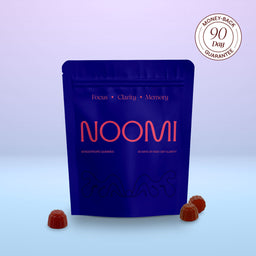
Four NOOMI gummies a day provide 200 mg of L-theanine alongside Alpha-GPC, bacopa, rhodiola and four other ingredients. NOOMI is licensed by Health Canada (NPN 80150439). It helps support cognitive function (such as mental focus and mental stamina), and it helps to temporarily promote relaxation. It is caffeine-free.
The NOOMI formula breakdown covers what each of the eight ingredients does and how long each takes.
L-theanine FAQ
Does L-theanine help with brain fog?
No trial has measured brain fog directly. What it can do is soften the stress response that often sits behind a foggy afternoon. It will not fix fog that comes from short sleep.
Can L-theanine help you sleep?
It is not a sedative, so it will not knock you out. But in a month-long trial, people taking it daily fell asleep faster and woke up less during the night than people on placebo.
Is L-theanine with coffee safe every day?
For most healthy adults, yes, as long as your total caffeine stays within Health Canada's limit of 400 mg a day. Watch the clock more than the dose: a large amount of caffeine even six hours before bed still cut sleep in a 2013 trial.
References
- Health Canada, Licensed Natural Health Products Database: NOOMI Gummies, NPN 80150439.
- Sakato Y. Studies on the chemical constituents of tea, part III: on a new amide, theanine. Nippon Nogeikagaku Kaishi, 1949.
- Vuong QV, Bowyer MC, Roach PD. L-Theanine: properties, synthesis and isolation from tea. Journal of the Science of Food and Agriculture, 2011 (review).
- Hidese S et al. Effects of L-theanine administration on stress-related symptoms and cognitive functions in healthy adults. Nutrients, 2019 (n = 30, 4 weeks).
Written by the Noomi team.