Why High Performers Ultimately Stall at a Cognitive Ceiling, Lose Their Edge in 3PM Deep Work, And What Finally Helped Me Break Through.
Jonathan J.
VP of Product Development & Founder
May 24, 20268 min read
I was three hours into a tough feature review. The kind where the whole team is in the room and someone has to actually pick a direction. I started laying out the trade-offs, the same kind of reasoning I'd done a thousand times, and I just stalled. Mid-sentence, the thread I was pulling on slipped. I caught myself saying "let me come back to this" twice in ten minutes. The third time, my manager picked it up. He was right. The argument was there. I just couldn't keep it loaded.
I'm not used to running out of stamina in the middle of my own argument.
It wasn't just the review. Context switching was costing more. A Slack ping mid-flow, and the mental model I had built to deliver my next best idea was gone. I'd walk to the kitchen and forget what I came for.
I'm working in tech. Juggling with concepts, frameworks and guiding the team to the best outcome, that's the basics of the job. I'd spent fifteen years getting good at it. And it felt like what made me successful wasn't mine anymore.
"Is this the cognitive ceiling everyone talks about? Did I reach my own Peter principle failing role?"
That was what I caught myself thinking, laying awake at 1AM.
I'd watched team mates I respected thrive for a few years and then quietly stall: stuck in the same role, passed over for promotion twice in a row, no longer able to take a step back and think outside the box. Just dull. Not because they got dumber. Because they ran out of juice and never refilled it.
I'd built a career on the assumption that I'd always be able to hold more context and be sharper than the next person. If that was starting to shift, I needed to know.
I was operating at a plateau: pressure, distractions, and corporate politics keeping me from pushing further into my assignments.
What I Tried Over The Next 18 Months
In tech we own performance like a system tightly monitored. I optimized the obvious knobs first:
The Caffeine Ladder
More coffee. Then tea plus coffee. Then a pre-workout dose at 2PM to ride out the afternoon. Then espresso in the evening to finish the night.
Tolerance built fast. Sleep got worse. The 3PM dip just moved to 4:30PM and brought anxiety/irritability with it.
The Single-Ingredient Nootropic
L-Theanine alone for a month. Then Alpha-GPC alone. Then Lion's Mane alone. Each from a respected brand, each at the dose the bottle recommended.
Each gave a slight bump for the first week, then it fades. None compounded. Single mechanism, single result.
The Coping Spiral
When neither caffeine nor pills moved the needle, I started falling into a pit of despair: sugar and snacks at 3PM, doom-scrolling between meetings to numb the exhaustion, Netflix or video games at night instead of the reflective thinking I needed.
Each one was a tax on the next day, a short terme relief paid for tenfold. The dip got steeper. The frustration compounded with the exhaustion.
It wasn't a discipline problem. It was a stack problem.
What Nobody Mentions About Cognitive Load Over a Long Sprint
The cognitive output runs on three systems: neurotransmitter availability, cellular energy, and stress regulation. All three drop together under sustained demand. Start with the first one.
Acetylcholine is the neurotransmitter the brain uses to retrieve the next thought before it slips, to encode new information, to load and hold complex context in working memory. The molecule that allows to keep a complex mental representation while the brain execute deliveries for hours. Production of acetylcholine is bounded by available choline AND by the activity level of the cholinergic system, which is directly suppressed by chronic cortisol elevation. So stress management isn't a "wellness add-on" to focus. It's upstream of the molecule that makes focus possible.
Under sustained cognitive load, the kind a high-output player week imposes, both supply and throughput of acetylcholine drop in parallel.
Normal ResponseRepeated HitsLack of AdaptationProlonged ResponseInadequate Response
Cognitive ceilings aren't about discipline and pep-talks. They're a fuel-and-stress-budget problem.
There are two other systems running below capacity under sustained demand, and they compound.
Cellular energy. Mitochondria are the structures inside every brain cell that convert nutrients into the energy that powers thought. Under steady high cognitive output, the kind a serious deep-work day costs, they don't have time to fully recover between sessions. Mental tasks that used to feel free, holding three threads in working memory, switching between two abstractions without losing either, start costing visible effort.
Cortisol regulation. Cortisol is the stress hormone. Under chronic mental demand, cortisol stays elevated. Elevated cortisol directly impairs the prefrontal cortex, the region responsible for focus and working memory. So there are three things happening simultaneously: less acetylcholine to retrieve the next thought. Less cellular energy to power deep work. More cortisol breaking down the cognitive systems.
The more stress is experienced, the more the body initiates allostasis, an adaptive cascade where hormones like cortisol and adrenaline crank up heart rate, blood pressure, and blood sugar to help meet the demand. The longer the exposure lasts, the longer the body takes to purge what builds up: the allostatic load.
Allostatic load is the price the brain and body pay for being forced to adapt to adverse psychosocial or physical situations.
SOURCE: McEwen 2007, Physiological Reviews
None of the solutions I tried addressed all three depletions at once. Not one rebuilt the system underneath.
THE COGNITIVE-LOAD LOOP
Cognitive demand spikes
Acetylcholine + dopamine deplete
Cortisol stays elevated
Mitochondria fall behind on recovery
You compensate: more caffeine, more sugar and snacks, late nights, skipped meals
Focus, working memory, and stamina fall
Repeat daily
Why do they deplete Specifically Under Sustained Demand
Research indicates that sustained attention and working memory are among the first functions to degrade under chronic cognitive load. The mismatch is brutal: at exactly the moment AI is raising the ceiling on what a senior professional is expected to ship per week, the underlying biological hardware is operating with depleted neurotransmitters and elevated cortisol.
The economic incentive is to push through and make money through those hours. The biology doesn't care. 😤
When I Found What My Brain Actually Needed.
I started reading clinical literature instead of wellness blogs.
The pattern I kept finding: the people who'd actually built sustainable cognitive performance protocols weren't relying on single ingredients. They were stacking compounds across the three depletion vectors: neurotransmitter availability, cellular energy, stress regulation.
I looked at the highest-upvoted ingredient choices on Reddit, r/Nootropics, r/ExperiencedDevs, r/Productivity, and started cross-referencing them against what Health Canada had actually approved.
r/Nootropics
Posted by u/keystroke_buffer · 3mo
Stack recommendations for sustained attention during long sprints?
Senior PM, 30s. After five years of grinding I'm noticing my deep-work blocks getting shorter and harder to recover from. I've cycled through the obvious stuff: caffeine ladder, single-ingredient Alpha-GPC, even tried modafinil for a week. Nothing compounds. Looking for an actually-stacked formulation that addresses the load side, not just the focus side. Anyone found something that survives a 60-hour week?
⬆ 312 47 comments Share Save
u/m_proc_42 · 3mo ago
L-Tyrosine + L-Theanine got me through my worst on-call rotations. Won't fix sleep debt but stops the cliff at hour 9.
⬆ 47 Reply Share
u/cli_native · 3mo ago
Anyone tried Noomi? Twelve days in. The fog at the back of my head when I'm context-switching between three projects is fading away. I genuinely didn't know my workday could be this clear.
⬆ 21 Reply Share
u/lifter_dev · 3mo ago
Short answer: most US stacks are underdosed. The synergies that actually stick: Coffee + L-Theanine, Bacopa + Rhodiola, Alpha-GPC + Phosphatidylserine. Source: ran the experiment on myself.
⬆ 12 Reply Share
There is no magic wand, one molecule alone isn't enough. A working brain at full output is a coordination problem between three systems, and a coordination problem can't be fixed with only one input.
But I learned there are natural compounds that directly supplement the chemicals the brain runs short of under load: acetylcholine is the obvious one. Those compounds are called nootropics.
I cross-referenced everything I found against Health Canada's Natural Health Product monographs, which is where I learned what's actually proven and what's marketing.
BINGO. I finally had a list of cognitive support ingredients validated by clinical research and a Canadian regulator.
Then I went shopping. What I found was that most nootropics sold to a North American audience are formulated oversea (in the US, or even worse in China), where the health supplement market doesn't have to prove dose-effectiveness to be on the shelf. The two regulatory regimes aren't equivalent, they aren't even close.
Half a research paper on the label, a fraction of the dose in the bottle.
"I'll Just Buy Lion's Mane on Amazon"
This is the moment most readers will close the tab and head to Amazon to search for nootropics. I did the same thing.
Lion's Mane is the most-recommended mushroom-based supplement for cognition right now. It is in every functional mushroom brand, every wellness influencer's morning routine, and most "brain support" listings on Amazon.
Here is what nobody mentions: ⚠️ Lion's Mane is NOT approved by Health Canada for any cognitive benefits in adults. The research that does exist is largely in elderly adults with measurable cognitive decline, not in senior professionals navigating the corporate world in their 30s and 40s, operating under crushing pressure.It has a single mechanism. It supports nerve growth factor, which matters for long term repair, not for load capacity needed day-to-day.
Lion's Mane
What Sustained High-Output Work Actually Requires
Designed for
❌ Nerve repair, nerve growth factor
✅ Cognitive ceilings under sustained load
Primary user
❌ Adults 65+ with cognitive decline
✅ Senior professionals 30 to 50 operating under crushing pressure
Mechanism
❌ Single (nerve growth factor)
✅ Neurotransmitters, energy, stress response
Addresses cognitive ceiling
❌ Partially, long-term
✅ Progressive lift as all three systems are refueled
Regulatory
❌ No Health Canada cognitive claim
✅ Health Canada NPN 80150439
Result
❌ Slight improvement after months
✅ Progressive clearing as all depleted systems are refueled simultaneously
If there is a specific high-stakes meeting where a complex argument needs to be presented with full clarity, acetylcholine is the molecule that supports it,
not Lion's Mane. But what challenge isn't a focus problem. It's a load problem.
A single-ingredient supplement gives back one of the lost pieces, and then it gets stuck. The wall moves a little. It doesn't dissolve.
What I Was Looking For, And What I Found
What I kept finding shopping that list was that most of these brands are based on an inspiring story selling fairy dust, not a medical product.
Open the bottle and the dose is a fraction of what the studies they cite actually require. I tested my way through eight of them. After three months, I almost gave up.
But then, Noomi compounded with the work I was already doing.
4.7
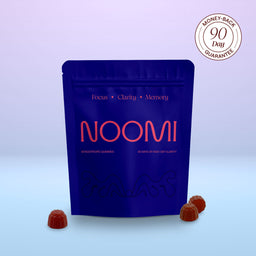
Noomi is the cognitive supplement I take every weekday morning. It's a Canadian formulation, made in Ontario, and it's the only one I've found that meets every criterion the research suggested mattered for someone operating at sustained high cognitive load.
All 3 depletion systems addressed
Working adult clinical dosage
Health Canada approved NPN 80150439
Made in Ontario, third-party tested
Tastes really good, I enjoy taking it every day
Every Ingredient Traces Directly to the Cognitive Systems
Noomi is the only formulation I found that doses for benefits at the clinically proven level the research used, in a single pill designed to work synergistically. Not wellness marketing but a stack that traces ingredient-by-ingredient to the load–depletion loop that impacts my day-to-day.
THE COMPLETE COGNITIVE STACK
Each layer addresses a different part of the load–depletion loop
Supports acetylcholine, dopamine, and focus-related signaling
Acetyl-L-Carnitine + Rhodiola rosea
Refuel mitochondrial energy production
Ashwagandha + L-Theanine + Rhodiola rosea
Lowers cortisol, increases emotional regulation
Full-stack synergy of all 8 ingredients
Focus, working memory, and stamina across the deep-work day
Full transparency: every dose listed, nothing hidden
🧠
Alpha-GPC
(The Focus Restorer)
400mg per serving
Crosses the blood-brain barrier and provides the choline the brain uses to produce acetylcholine, the neurotransmitter responsible for word retrieval, memory encoding, and processing speed. The molecule that drops with age.
In a randomized double-blind trial, healthy adults who took Alpha-GPC completed cognitive processing tasks 18% faster than those given caffeine, with no jitter or crash.
🔋
Acetyl-L-Carnitine
(The Energy System)
500mg per serving
Supports mitochondrial function, the cellular energy generators inside every brain cell. Helps convert fatty acids into the energy that powers thought across long workdays. This is what restores the capacity that used to feel effortless.
Clinical research has examined it for age-related cognitive support, particularly in adults experiencing reduced mental stamina.
🎯
L-Tyrosine
(The Pressure Performer)
500mg per serving
The amino acid the brain uses to produce dopamine and noradrenaline under stress. This is the one that holds performance together when the deadline is real.
Studied by the US military for sustaining cognitive performance in demanding conditions, L-Tyrosine helps decrease cognitive fatigue during physically and mentally stressful situations.
🧱
Phosphatidylserine
(The Structural Layer)
300mg per serving
A naturally occurring phospholipid concentrated in brain cell membranes. Supports the structural conditions that allow neurons to communicate efficiently. Health Canada-recognized for memory enhancement.
A 12-week clinical trial showed memory improvements in adults with age-related memory complaints at this exact dose.
📦
Bacopa monnieri
(The Memory Builder)
300mg per serving
A traditional herb with one of the strongest evidence bases for memory enhancement. Works by promoting dendrite branching, the connections between brain cells. Effects build over weeks of consistent use, not days.
In a meta-analysis of nine randomized controlled trials, Bacopa monnieri decreased reaction time by approximately 11 milliseconds and improved task-switching speed by 18 milliseconds at this exact dose.
🛡️
Ashwagandha
(The Cortisol Regulator)
300mg per serving
An adaptogenic herb with the strongest clinical evidence base for cortisol regulation. Helps the nervous system clear stress between demands instead of accumulating it across a long sprint.
In a clinical study, Ashwagandha reduced cortisol levels by 27.9% and significantly improved cognitive performance under stress.
🔍
L-Theanine
(The Calm Focus)
200mg per serving
The amino acid in green tea that increases alpha-wave brain activity, the same brain state measured during meditation and flow states. Produces the state of calm alertness that disappears when operating on caffeine and adrenaline.
L-Theanine at this dose has been shown to increase alpha-wave brain activity within 30 to 45 minutes.
🏔️
Rhodiola Rosae
(The Mental Stamina)
144mg per serving
A Canadian-native adaptogen. Helps decrease cognitive fatigue under prolonged mental demand. The 2pm and 4pm walls knowledge work runs into.
Research on night-shift doctors and students has shown Rhodiola rosea reduced mental fatigue and cortisol response and improvement in burnout symptoms.
What People Are Saying About Noomi
4.7
Based on verified reviews
JB
Jean-François B.Ottawa · 2 reviews
3 days ago
✓ Verified
Didn't think it would do anything
I've tried three or four of these from the US and got nothing out of any of them. Bought this one mainly because it's Canadian and I figured worst case I'm out a month. About two weeks in I realized I'd stopped grabbing a coffee before our 4pm standup. That was the tell for me.
M
MarioCalgary · 1 review
10 days ago
✓ Verified
Worth it if the budget's there
Not cheap. But I was buying eight separate products before this and spending more, so the math actually works out. One bottle, one routine, done.
DC
David C.Mississauga · 5 reviews
4 weeks ago
✓ Verified
Saved my afternoons
I was overwhelmed and tired. I'd be there but not really there. Now I can hold an actual deep work block after lunch instead of pushing everything to the evening. They taste good too, which sounds minor until you're taking something daily.
JK
James K.Halifax · 11 reviews
6 weeks ago
✓ Verified
I was about to call my doctor
46, fifteen years in engineering management. This past year I'd started feeling like the people half my age on my team were outpacing me. They feel more efficient and fast. Three months on this and I'm the one driving the architecture calls again. I had an appointment booked to ask about Adderall. I cancelled it.
MS
Michael S.Québec · 3 reviews
7 weeks ago
✓ Verified
Took about a week
First few days, nothing. Around day eight something shifted. Best way I can put it is calm but switched on. I got through a two week sprint without the usual crash at the end of it.
L
LucasWaterloo · 1 review
4 months ago
✓ Verified
Stick with it
Almost quit at week four. Nothing was happening and I felt dumb for spending the money. Week six I noticed I was getting through my mornings without that wading through mud feeling. Give it a full quarter before you judge it.
R
RedouaneBurnaby · 8 reviews
5 months ago
✓ Verified
Does what it says
The thing I notice most is in meetings. I can follow a thread and respond to it without losing my place, and I'm not rehearsing sentences in my head before I say them anymore. It's a bit like coffee except coffee makes me anxious and this doesn't. That was the whole reason I went looking for an alternative.
MB
Michel B.Laval · 14 reviews
6 months ago
✓ Verified
Bigger effect than I expected
I picked this up to help me focus on running my company. It did that. What I wasn't expecting was the other thing. I've had social anxiety for as long as I can remember and client calls were genuinely hard for me. Not hard like I didn't enjoy them. Hard like I'd reschedule them twice. That's mostly gone now. My pipeline is the healthiest it's been in three years and I'm not dreading the work that fills it. Only downside is I stay up later than I used to, though I sleep fine once I do go down.
What I Experienced Week by Week
Week 1
My first sustained 3-hour block came back.
Mid-afternoon, I noticed I still had the bandwidth to keep thinking. The grogginess between meetings was lighter.
Week 2
I held context through a 2-hour design review without losing the thread.
I argued my position cleanly through every counterproposal. The mid-meeting fade I'd been working around just didn't happen.
Weeks 3-4
My manager started noticing.
"You're shipping at a different tempo." That high-performing version of myself was coming back.
Weeks 5-12
I'm operating at the line I always knew was there.
The reviews I drive are the sharpest in the room. I close tickets without context-loss between them. The ceiling I was hitting hasn't come back.
THREE MONTHS IN I have my flow back. I used to lose the day to context switching, and after 2PM my focus was gone. Now my best blocks are happening in the back half of the day. I keep a doc open for the creative ideas that come at 8PM. I sometimes notice it's past 6 and I'm still productive, inspired, in control, and there's nothing forcing it. I haven't hit the wall once. The biology underneath finally compounds with the work I'm already doing.
90-Day Complete Money-Back Guarantee
If you're not satisfied, we'll refund 100% of what you paid, including shipping.
✓ Health-Canada approved✓ Full refund, no conditions✓ Third-party tested
The Honest Questions
I've tried other cognitive supplements before. Why would this one be different?+
Most of what's available is either underdosed (below the clinical threshold) or single-mechanism. Cognitive ceilings under sustained load are three depleted systems. Anything that targets one will produce some improvement and then plateau. Noomi addresses all three at clinical doses. The multi-ingredient NPN is the regulatory standard that proves it.
I already drink coffee, and sometimes pair it with L-Theanine. Do I really need this on top?+
Coffee handles arousal and short-term focus. L-Theanine smooths the jitter. Neither replenishes acetylcholine, refuels mitochondria, or regulates cortisol, the three systems that actually drop under sustained cognitive load. Noomi works alongside your coffee, on a different layer of the same problem. Personally, I even switched to decaf and no-caffeine tea to optimize my nights now that my days are boosted by Noomi.
Will it make me jittery like caffeine does?+
No stimulants. Our formula is actually designed to pair beautifully with your morning coffee: L-Theanine (200mg) is scientifically shown to smooth out caffeine's jittery effects while enhancing focus. Plus, Ashwagandha and Rhodiola provide natural calm. You won't feel a sudden "kick" like with caffeine. Instead, you'll notice smoother, more sustained cognitive performance. Many describe it as feeling like their "best brain day" becomes more consistent.
What happens if I stop taking Noomi?+
Noomi doesn't create dependency. Unlike stimulants, you won't experience withdrawal symptoms if you stop taking it. The ingredients work by supporting your brain's natural systems rather than overriding them. That said, the benefits are cumulative; consistent daily use allows these nutrients to build up and work most effectively, and the weekday-only protocol is built to prevent your brain from adapting, which keeps the effects strong over time.
LIMITED-TIME WELCOME OFFER
35% OFF Your First Order
For professionals ready to compound the work they're already doing.