TL;DR
- Adderall is a prescription stimulant for a diagnosed condition. It acts fast and hard on dopamine and norepinephrine. No supplement matches that, and anything sold as "natural Adderall" is overstating itself.
- Most people searching for an alternative don't have a prescription. They want the focus, not the diagnosis, which is a reasonable thing to want.
- For the specific things Adderall gives you (drive, calm focus, energy, retention), a few natural compounds have real but modest evidence, at specific studied doses.
Why so many adults are looking for Adderall alternatives
Interest in stimulants has climbed fast, and Canada is no exception. In Ontario, the rate of stimulant prescriptions rose 157% between 2015 and 2023, with adults driving the growth and the sharpest jump of all among women aged 25 to 44 (ICES and SickKids study). Alongside that trend is a large group who never get a prescription at all. They don't have ADHD, or don't want to chase a diagnosis, and they still want to focus like the deadline depends on it.
The forums make the split obvious. Some people are tapering off medication and want a softer landing: "I'm in the process of tapering off Vyvanse because I don't want the long-term side effects. What are some supplements recommended to take to increase dopamine and norepinephrine levels?" Others are stuck on a diagnosis waitlist, or wary after the shortage years. And plenty are clear-eyed about the trade: "I'm willing to try anything that might improve mood, focus, energy, and motivation."
Both quoted posts came up in the audience research we did before formulating. Nobody in those threads thinks a gummy matches a drugs. They're asking the reasonable version of the question: for the focus I actually want, what has evidence?
First, the hard part: what Adderall actually does
Adderall is a mix of amphetamine salts. It forces your neurons to release dopamine and norepinephrine and blocks them from being reabsorbed, which floods the attention and executive-function circuits with signal. The extended-release version comes on in 30 to 60 minutes and runs about 10 to 12 hours. That is a direct, fast, powerful mechanism, and it's why Adderall is a controlled substance handled under medical supervision.
It also comes with a bill. Tolerance builds as the brain downregulates its own receptors, so the month-one effect isn't the month-six effect. The side effects are well documented: disrupted sleep, appetite loss, a raised heart rate, anxiety, irritability, and a crash as it clears.
Natural compounds don't do any of that. At best they work upstream or sideways, supplying raw materials or calming the stress that erodes attention. Ask which one is "like Adderall" and the honest answer is none of them. Ask which even touches the dopamine pathway and the list shrinks to essentially one, tyrosine, and even tyrosine hands over raw material rather than forcing a release. The realistic expectation from any natural option is a modest, cumulative improvement on an ordinary day. If that sounds underwhelming, good. It's a different tool for a different job, and pretending otherwise is how this industry loses people's trust.
What natural options actually do, by what you're after
Strip Adderall down and it does a few specific jobs. It gives you the drive to start, the focus to stay on task, the energy to push through fatigue, and enough quiet in your head to not get pulled away. No supplement delivers all four at that strength. But for each one, there's an honest answer about what the evidence supports.
The drive to get started
This is the piece people miss most when they come off a stimulant, and it's the hardest to replace. The one natural compound with a mechanism in the same system is L-tyrosine, the amino acid your brain turns into dopamine and norepinephrine. It supplies the raw material without forcing the release, which is exactly what makes it a precursor and not a stimulant. Jongkees and colleagues (2015) found it helps maintain cognitive performance under acute stress, sleep loss, or heavy load. Useful for a draining afternoon.
Focus without the jitters
The most reliable natural answer here isn't a stimulant at all. L-theanine, from green tea, calms the stress arousal that fragments attention. Kimura and colleagues (2007) found a 200 mg dose lowered heart rate and stress responses under pressure, and paired with caffeine it improved attention-switching better than caffeine alone (Owen and colleagues, 2008). It clears the noise so the focus you already have can land.
The stress that scatters attention
A lot of what feels like a focus problem is a stress problem in disguise. Chronically high cortisol measurably degrades working memory. Two adaptogens have real trial evidence on that pathway. Ashwagandha cut cortisol by roughly 28% over 60 days at 300 mg twice daily, and rhodiola reduced mental fatigue in night-shift physicians over two weeks. Neither touches dopamine. Both address a genuine reason attention falls apart under load.
Holding on to what you learn
Adderall helps you absorb and retain while it's working. The closest natural evidence is bacopa, which improved memory consolidation at 300 mg daily after 8 to 12 weeks, and omega-3 as the structural baseline, small but consistent in the trial data. Choline sources like alpha-GPC feed acetylcholine, the learning-and-attention signal, though the strongest trials used high doses in older adults. All of it is slow, and worth knowing that going in.
Adderall vs Noomi, side by side
Here's the honest comparison, including where Adderall wins outright. They are built for different situations.
| Adderall XR (prescription) | Noomi (supplement) | |
|---|---|---|
| What it is | Amphetamine salts, a controlled medication | A Health Canada licensed nootropic gummy |
| Mechanism | Forces dopamine and norepinephrine release, blocks reuptake | Supplies precursors and supports the stress and energy systems around focus |
| Onset | 30 to 60 minutes | Builds over days to weeks |
| Duration | 10 to 12 hours | Daily and cumulative |
| Tolerance | Common, as receptors downregulate | No tolerance curve |
| Side effects | Sleep loss, appetite loss, raised heart rate, anxiety | Mild |
| Crash | Common as it wears off | None |
| Prescription | Required, controlled substance | None |
| Best for | Diagnosed ADHD, under medical care | Everyday focus support for work-related stress |
This isn't a substitution chart. Adderall treats a diagnosed condition under a doctor's care, and for that job nothing on the supplement shelf competes. Noomi is a stimulant-free option for the person who doesn't have that prescription and wants steady daily support. If you take medication, the plan you have with your clinician comes first.
A better way to Stay focused
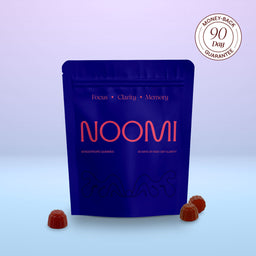
Noomi is what we landed on for people without a prescription who want a stimulant-free way to support focus. It's a Health Canada licensed nootropic gummy made in Canada that helps support cognitive function, mental focus and mental stamina, and helps increase energy and resistance to stress over time.
It's built to work across several of the pathways above at once, a dopamine precursor, a choline source, stress regulation, and cellular energy, rather than leaning on any single one. That's the honest meaning of stimulant-free, and it's why people describe the feeling as calm and focused instead of wired.
The one number that matters is the dose. You can see the full breakdown, and what we left out and why, in our ingredients breakdown.
To be clear about what it isn't: Noomi is not a treatment for ADHD and not a replacement for any medication. If you're managing ADHD with a clinician, that plan comes first. If you're an adult dealing with everyday brain fog and afternoon fade, and you want something to build a focus routine around, that's who we made it for.
FAQ
Is there such a thing as natural Adderall?
No. Adderall is a prescription amphetamine that acts directly on dopamine and norepinephrine, and nothing natural replicates that mechanism or effect size. The closest any natural compound gets is tyrosine, which supplies the raw material for dopamine without triggering its release. Anything marketed as "natural Adderall" is overstating itself on that basis alone.
Do nootropics work for ADHD?
Nootropics are not a treatment for ADHD. If you suspect ADHD, the evidence-based path is an assessment and a plan with a clinician.
Can I take focus supplements alongside ADHD medication?
Only with your prescriber's sign-off. Some ingredients act on the same systems as medication, and interactions are individual. Bring the specific label to the appointment.
What's the closest over-the-counter option to a stimulant?
Realistically, caffeine, ideally paired with L-theanine to blunt the jitters. It's the strongest legal OTC stimulant, and it comes with tolerance, crashes, and sleep costs. That trade-off is why stimulant-free supplements aim for steadier gains instead.
Is it safe to stop Adderall and switch to supplements?
Never stop or change prescribed medication without your doctor. Supplements are not a substitute, and coming off stimulants should be medically supervised.
This article is for information only and is not medical advice. Noomi does not diagnose, treat, or prevent ADHD or any medical condition. Never stop or change medication without your doctor. Noomi's benefit statements are limited to its Health Canada verified claims.
If you want a stimulant-free way to support focus: Noomi is a Health Canada licensed nootropic gummy, made in Canada, for ambitious professionals under pressure.